

Thank you.

natCollins
My first official outing as “Dr Nat” — didn’t even have time to update my name badge.

I received some exciting news this month, I have finally been formally recognised as completing all of the requirements of my PhD. That’s right, I have finished the program I commenced in 2008.

Getting a PhD was easier–and harder–than I thought. My undergraduate degree in Philosophy had given me a great foundation for research work. My ability to argue was also very well developed (some would say overdeveloped); so taking a position and then seeking to prove or disprove it was less of a challenge to me than it might have been to others.

The emotional journey, however, was harder than I anticipated. This was a long project as I worked full time while I encountered every beaurocratic frustration in my path. The hardest part of this was not the work. It was the stuff surrounding the work.

All the while though, my network of family, friends and colleagues spurred me on. Between now and September when I cross the stage, I will spend much of my time thanking them all individually. After that, my job is to pay it forward and support others. I am looking forward to that.
New Journal Article Published: “Civitas and Communitas”

Recently the Journal of Global Marketing Science published a special issue on Philosophy and Marketing. Professor Jamie Murphy and I were published in that journal with our article: “Communitas and civitas: an idiographic model of consumer collectives”

The article is part of a two part conceptual journey into consumer collectives. Also called Brand Communities, Consumer Tribes, Subcultures of Consumption and other such names, these communities have products at their centre and act a lot like religious communities. This article draws a comparison between religious communities (as it is defined by American James Carse) and these consumption communities. The comparison explores the tension between the Civitas (or producer/church) and the Communitas (congregation/consumer collective). The two groups do not have the same aims; rather their goals produce a social energy or “game” which generates meaning for all the players.

The contribution of this article is the development of a model of communal consumption behaviour which is mapped to a particular model of the way religion works. Parallels between consumption behaviour and religion have become increasingly common since Apple Computer introduced the approach in the mid 1980s. This article also highlights the work of James Carse, an American scholar of Philosophy and Religion.


Advertising Textbook Contribution

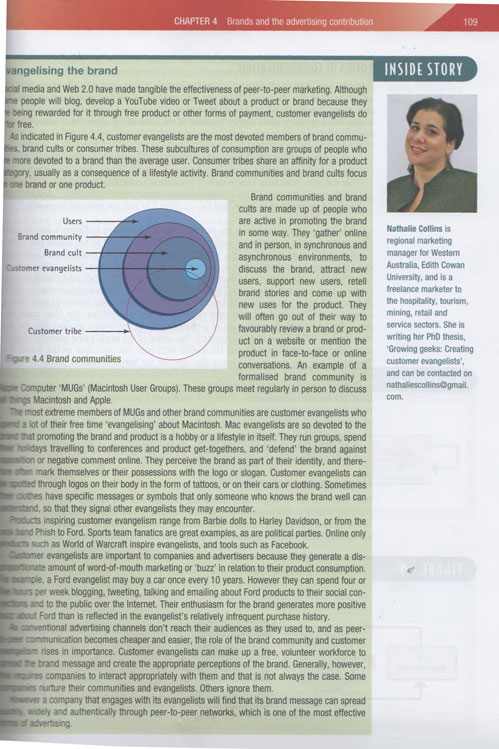
Several years ago, I contributed to an Australian Edition of a university Advertising textbook. I recently was asked to revisit my contribution, as they have decided to use the work I contributed on Customer Evangelism again. It is great to see this kind of research being included in a text used to teach Communications students. I was particularly chuffed that the textbook is being used at the university where I work, Edith Cowan University.

Below is an excerpt from the original contribution to the book.

NatBookW

Paper Presentation on Authentic Student Recruitment

Edith Cowan University recently hosted their Teaching and Learning eCulture Conference. Along with colleagues Lynelle Watts, Renee Strauss, David Hodgson and Richard Brightwell, I presented a paper called “Authenticity in Student Recruitment: Social Work and Paramedicine”. The paper examined the relationship between recruiters and academics at ECU in two programs which had grown in student enrollments over the last 3-5 years. Using a convergent interviewing methodology, we examined the events that led up to and precipitated the ability of recruiters to sell these two courses authentically to future students.

Some of the outcomes included:

(1) Uncertainty on behalf of Academics on how the marketing and sales process works ended up being the catalyst for a constructive relationship;

(2) Courses with the most unmet market demand would tend to get the most attention from recruiters;

(3) Recruiters are more likely to focus on the corporate brand as a form of credibility than Academics do; and

(4) Course accreditation adds value to the future student and current student experience.

Authenticity in relationships between recruiters and academics is not covered in scholarly literature. This study is a step in the direction of exploring what makes an effective recruiter in higher education.

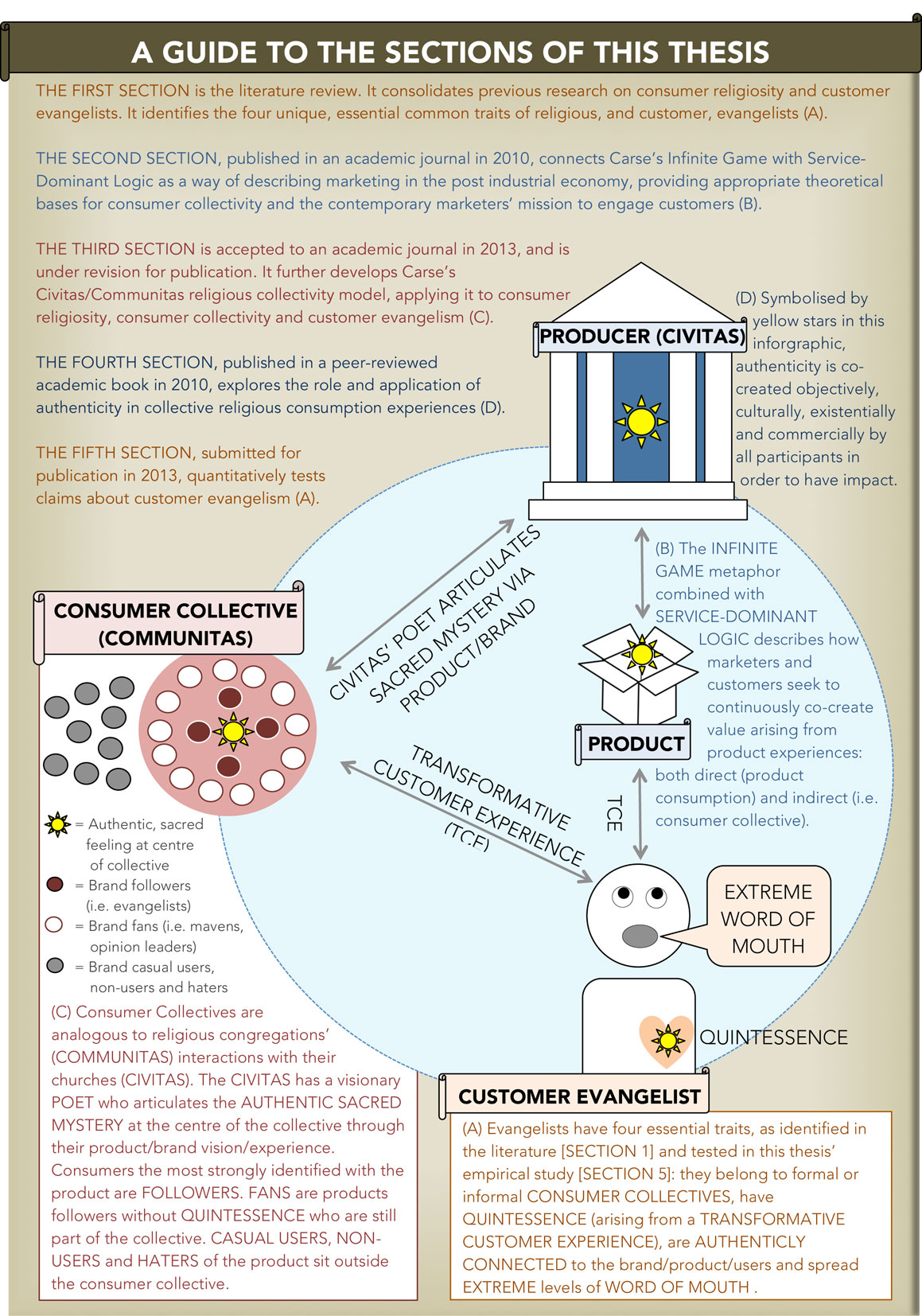
An Infographic on a new theory of Customer Evangelism

I am currently completing (hopefully) a PhD program. I put the following infographic together in order to lead people reading the thesis through the document. This inforgraphic outlines the original contribution of the thesis over the course of 5 sections, or articles, I have written. Two are published, one is slated for publication and the other two being finalised for submission.

The following graphic is large, please give it time to lead if you have a slow connection. Please click on it to see a larger version, or email me and I can send you a PDF.

Comments are welcome.

Inforgraphic

Two Papers in the Las Vegas Services Forum

I recently received excellent news: two papers I authored have been accepted int the Service Management and Science Forum in Las Vegas this August. I will be traveling to Vegas to present the papers.

One paper is called Network Narratives Revisited and looks at how authenticity affects audience acceptance of seeded commercial blog posts.

Another paper is called Developing a Customer Evangelism Scale Using Faith-Based Volunteer Tourism Data. This paper, co-authored with Professor Jamie Murphy, is the first step toward using quantitative techniques to identify customer evangelists from a larger sample population.

Two Papers in China

I am lucky to have a colleague, Jamie Murphy, present two papers we collaborated on at the Asia-Pacific Council on Hotel, Restaurant and Institutional Education Conference in May this year.

The first paper is called The Road to Damascus Leads to One Infinite Loop:
An Introspective Adventure into Apple Computer Customer Evangelism. It is an introspective account of one Apple user’s journey to evangelism (me!).

The second paper is called Towards A Folk Taxonomy of Popular New Media Marketing Terms and classifies terms we use all the time in common language and in marketing: Geek, Maven, Alpha User, Evangelist, Fanboy. It is a folk taxonomy primarily because these words came to be used in the common vernacular in the first instance. Later they were co-opted into technical marketing terms. There is still a lot of confusion around these terms and the purpose of the paper is to carve out an evidence-based place for each term.

Thanks to Jamie for traveling to China and presenting these papers on our behalf.


Two Papers at the World Marketing Congress, Melbourne Australia

I am pleased to share that I will be delivering two papers in Melbourne at the Academy of Marketing Science’s World Marketing Congress.

One, titled The Ideal Marketer is an Authentic Marketer, is another paper supporting the 360 Authenticity Framework which was the subject of a book chapter and conference paper I co-authored.

The other, titled Of Geeks and Achievers: Brand Community Tourism and the Infinite Game further supports the papers I co-authored on Brand Communities and the application of the Infinite Game metaphor to marketing.

The papers will be posted to this web site later in the year, however feel free to contact me if you wish t have a preview.